In Q2 2024, this project required surface preparation for roughly 12,000 ㎡ of aged concrete floors within five weeks, to create a clean, uniform substrate that meets adhesion requirements for subsequent epoxy flooring installation. Previously, the contractor used walk-behind grinders with manual sweeping. The overall efficiency was only around 80–100 ㎡ per hour. Dust control was challenging, and surface roughness often turned out uneven.
Construction took place in Malaysia’s hot and humid climate, where concrete surface conditions fluctuate with weather and humidity. Some areas might suffer from damp surfaces, residual laitance, or inconsistent texture before coating, which compromises the bonding of later coatings. To finish floor preparation within the schedule, the customer finally adopted the floor blasting machine solution supplied by YG. With higher working speed, more consistent surface quality, and dust removal setups built for Southeast Asian conditions, the project’s overall delivery timeline was improved.
Floor Blasting Machine Specifications
Model
YG-270(Single)
YG-550/600(Double)
YG-850(Double)
Shot Blasting Wheel Diameter
200mm
Working width
270 mm
550/600 mm
800 mm
Walking speed
0.5~20 m/min
0.5~33 m/min
Concrete surface cleaning efficiency
≥180 m2/h
≥400 m2/h
≥600 m2/h
Steel plate surface cleaning efficiency
15-25 m2/h
75-100 m2/h
100-160 m2/h
Dust connection pipe diameter
120 mm
150 mm
Suggest the diameter of steel balls
1.2-1.5 mm
1.5-1.8 mm
Steel pill consumption
10 g/m2
Supporting dust collector
Seven-core automatic backflush vacuum cleaner
Eight-core automatic backflush vacuum cleaner
Shot wheel motor
Power consumption
11 kW
11*2 kW
15*2 kW
Input Current
≤ 15 A
≤ 22*2 A
≤ 28*2 A
Walking motor
Power consumption
0.5 kW
1.5 kW
Input Current
1 A
3 A
Size (mm)
1000*300*1100
1950*720/775*1400
1950*1020*1550
Weight
150 kg
570 kg
700kg
Power connection requirements
400V, 50Hz, 100A, CEE socket
Project Background: Why Malaysian Contractors Needed a More Efficient Solution
The customer is a concrete contractor serving Malaysia’s commercial flooring, industrial plant, bridge waterproofing and municipal maintenance projects. As project sizes and construction standards rise, traditional grinding struggles to meet tight deadlines, environmental rules, labour budgets, and coating quality demands all at once.
This project was located inside a logistics and retail mixed complex in Kuala Lumpur. After years of service, parts of the floor retained old coatings, surface laitance, light oil stains, and inconsistent substrate texture. An epoxy system would be applied afterwards, so the contractor first had to remove weak surface material and create uniform roughness for coating adhesion.
The schedule was extremely tight. The customer needed to prepare about 12,000 ㎡ of concrete substrate in five weeks, leaving sufficient time for the coating team to work and complete acceptance. Slow substrate preparation would directly compress the whole project delivery window.
Challenges of Traditional Concrete Surface Preparation
The original workflow relied on walk-behind grinders for surface sanding, paired with industrial vacuums and manual cleaning to remove dust and residue. This method works for small patch repairs, but on large commercial flooring jobs, grinding, sweeping, rechecking, and rework drastically lower actual output.
When accounting for grinding, manual sweeping, touch-up grinding, and quality checks, on-site productivity was only 80–100 ㎡ per hour. At this rate, the 12,000 ㎡ job would consume excessive working time and hold up later epoxy works waiting for substrate readiness.
Traditional grinding also tends to create uneven surface texture. Some spots get over-ground while others still hold laitance or leftover old coating. Early coating adhesion tests on site showed a pass rate of roughly 75%, meaning crews had to reprocess failed areas.
Malaysia’s hot, wet climate added further site management difficulty. High night-time humidity, intermittent rain and poor local ventilation can destabilise concrete surfaces. The contractor needed faster preparation, less dust generation during works, and dry, water-free floors before blasting.
For these reasons, the customer began evaluating concrete floor shot blasting machine options. During sourcing, they actively searched for concrete shot blasters for sale suitable for large-area concrete substrate treatment. Compared with continuous manual grinding, shot blasting completes concrete surface cleaning, texturing, steel shot recovery, and dust capture in one continuous pass, making it better for high-spec, large-scale jobs with tight schedules.
Selecting the Right Floor Blasting Machine for Malaysian Working Conditions
Instead of choosing purely based on quotation or working width, the customer evaluated models by daily project output, site access, dust control performance, on-site power supply, consumable usage, ease of maintenance and supplier support capacity.
The core project goal was to finish substrate preparation ahead of coating works. The machine needed to reliably cover wide open floors while remaining manoeuvrable around columns, loading bays and transition zones. In addition, given the common high-temperature, high-humidity conditions across Malaysia and Southeast Asia, consistent dust collector performance was a major concern.
Technical Requirements for Tropical Concrete Surfaces
Machinery for concrete substrate prep must match site conditions. For this project, slab unevenness had to stay within 10 mm; floors must be free of standing water and kept relatively dry. The machine’s allowable slope is below 25°, which covers most floor areas in this commercial complex.
In terms of throughput, the single-wheel YG-270 has a 270 mm working width. It suits patch repairs, small floors, ramps, and precision finishing. Under suitable concrete conditions, this model can deliver cleaning speeds above 180 ㎡/h.
However, a single-wheel unit could not meet the schedule for this 12,000 ㎡ large commercial floor. The dual-wheel YG-550 and YG-600 offer working widths of 550 mm and 600 mm, respectively. Under proper conditions, they achieve concrete cleaning efficiency over 400 ㎡/h. For airport runways, bridge waterproofing, large factories and municipal road works, the dual-wheel YG-850 has an 800 mm working width and can process over 600 ㎡/h.
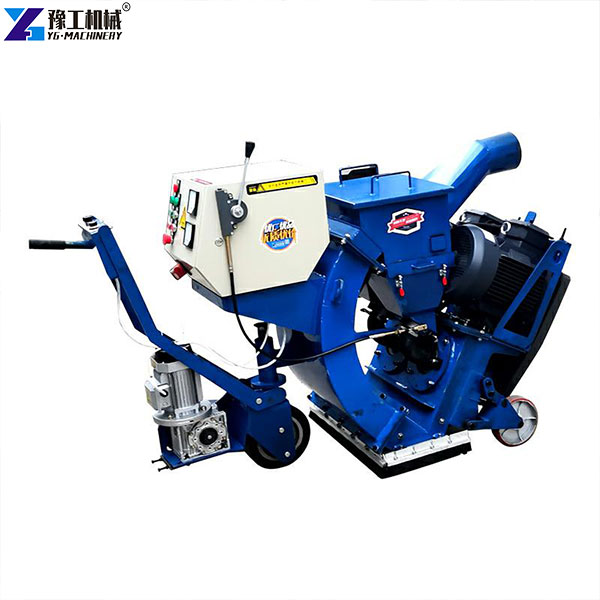
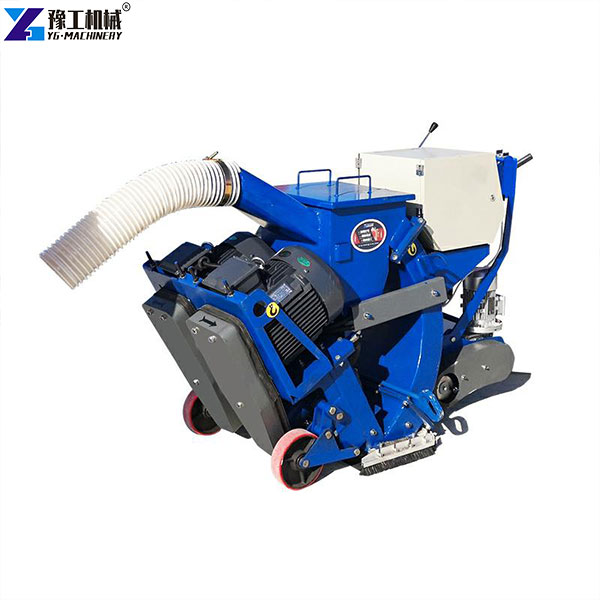
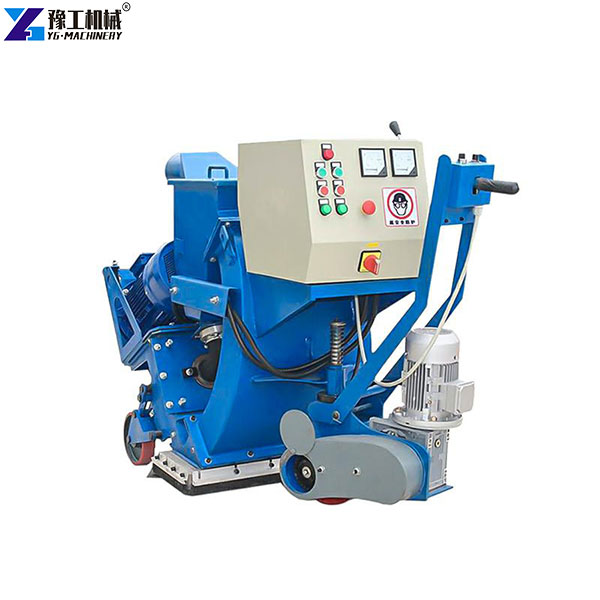
The customer finally selected the dual-wheel YG-550. This model balances high throughput and site mobility, maintaining fast production on wide floors while navigating columns, corridors, and edge zones common in commercial builds.
Dust removal capacity was another key technical factor. For dual-wheel machines, an eight-core automatic backflush dust collector is recommended. The auto backflush system keeps filter performance stable during long shifts, which is especially critical for continuous work in Malaysia’s humid environment.
For shot selection, dual-wheel models such as the YG-550 normally use 1.5–1.8 mm steel balls to produce a surface profile ideal for epoxy flooring or waterproofing systems. Single-wheel machines like the YG-270 pair better with 1.2–1.5 mm steel balls for finer patchwork and small areas.
Why the Customer Chose the YG Floor Blasting Machine
For this Kuala Lumpur project, YG recommended the dual-wheel YG-550 shot blasting machine for concrete, matched with an eight-core automatic backflush dust collector.
The YG-550 uses two 11 kW shot blast motors plus one 1.5 kW travel motor, fitted with 200 mm blast wheels. Its dual-wheel layout delivers relatively even shot coverage across the 550 mm working width, helping crews achieve consistent substrate roughness and lowering risks of under-treatment or over-treatment in spots.
Power requirements were confirmed early in model selection. The unit calls for 400 V, 50 Hz, 100 A power with a CEE industrial plug, matching the three-phase power commonly available on Malaysian industrial sites. Verifying electrical requirements in advance prevented schedule delays after machine delivery caused by incompatible sockets or power supply.
YG also advised the customer to carry out a small test blast before full-scale production. The purpose was not site training, but to verify the match between machine settings, concrete substrate and coating system. Crews could adjust travel speed, shot flow and blast intensity based on post-blast cleanliness, roughness and adhesion test results, then lock those parameters in for the whole project.
Delivery, Commissioning and Technical Support in Malaysia
Once the machine solution was confirmed, YG and the customer completed pre-delivery technical checks. Both sides locked in model, dust removal configuration, shot size, total estimated treatment area, site power parameters, arrival timeline, and shipping plans to reduce miscommunication and uncertainty after arrival.
The project finalised the dual-wheel YG-550 shot blaster plus eight-core automatic backflush dust collector. Its two 11 kW blast motors, 1.5 kW travel motor, and 200 mm blast wheels meet the job’s demand for fast concrete cleaning. With suitable site conditions and calibrated settings, the machine can hit over 400 ㎡/h.
After production and factory readiness, YG shipped the YG-550 main unit and supporting dust collector by sea to Malaysia. The delivery scope includes export packing, ocean freight, destination port clearance coordination, and transport to the Kuala Lumpur site. Forward planning for sea freight and arrival dates allowed the customer to receive equipment before large-area substrate preparation started.
After arrival, YG provided remote technical support to help the customer verify installation, power connection, dust collector hookup, and shot filling. Remote support also covered machine documentation, baseline operating parameters, troubleshooting guidance, and wear part replacement tips, so the customer completed required technical checks before starting work.
Small-area test blasting remains a vital quality checkpoint for any large shot blast project. The customer tested on representative zones before full production, checking concrete cleanliness, roughness, and compatibility with the epoxy coating system. Travel speed, shot flow, and blast strength were tuned from test results to create stable operating parameters for the project.
Considering Malaysia’s high humidity and frequent rain, the customer built substrate condition checks into the construction plan. Shot blast machines must run on dry floors with no standing water and should not operate outdoors during rain. Careful scheduling cuts rework risks from damp substrates.
For buyers currently comparing concrete shot blaster for sale, post-delivery support directly affects project startup speed. YG assists with machine deployment and project kickoff via remote technical communication, documentation, spare part guidance, and operational issue response; on-site training is not included.
Project Results: Performance Data from the Malaysian Site
This case proves that a properly selected floor blasting machine accelerates concrete surface preparation while improving substrate consistency, coating adhesion and on-site dust management. After test blasting, parameter lock-in, and stable operation, the customer substantially shortened substrate preparation cycles.
Comparison Item
Original Grinding Method
YG-550 Dual-Wheel Shot Blast Solution
Concrete surface preparation efficiency
Around 80–100 ㎡/h including sweeping
Over 400 ㎡/h under suitable working conditions
Consistency of surface roughness
Heavily affected by operator and grinding conditions
More uniform shot coverage and stable texture
Coating adhesion test pass rate
Around 75%
Around 98%
Cleaning method
Manual sweeping, industrial vacuuming, and local rework
Shot recovery and matched dust extraction run simultaneously
Rework risk before coating
High
Greatly reduced after test blast and parameter control
The old process delivered roughly 80–100 ㎡/h, including manual sweeping, touch-up rework, and quality inspection. After switching to the YG-550, concrete cleaning speed exceeded 400 ㎡/h when site conditions were acceptable. Compared with the old workflow, substrate preparation productivity rose by at least four times.
Shot blasting improved roughness consistency. The machine removes concrete laitance, old coating residue, and surface contaminants while creating a uniform mechanical profile. After test blasting and parameter optimisation, the coating adhesion pass rate increased from about 75% to roughly 98%.
For operating costs, the customer planned wear part consumption in advance. Liner sleeves and blast wheels have a reference service life of approximately 20,000 ㎡. Top and side liners last around 50,000 ㎡. Including wear life in procurement and project budgeting reduces downtime and emergency spare part purchases.
Shot consumption also needs forecasting for large projects. Normally, steel shot usage is about 10 g/㎡. For example, a 50,000 ㎡ bridge deck waterproofing profiling job typically requires 2–3 tonnes of shot or grit. Actual consumption depends on shot recovery efficiency, concrete substrate, and operational settings.
This solution also applies to Penang bridge waterproofing jobs, Malaysia highway bridge and tunnel maintenance, and major industrial floor refurbishments. For contractors using a concrete floor shot blasting machine, stable surface texture and effective dust collection reduce later manual cleaning hours and improve bonding reliability for waterproof membranes, coatings, or repair materials.
The matched dust collector drastically cuts visible dust on site. While all construction machines require regular maintenance, shot blasters recover shot and filter dust during operation, removing the heavy manual sweeping and repeated vacuuming needed after traditional grinding. This near-dustless working approach helps contractors meet Malaysia’s site environmental management requirements.
Contact YG
This case shows that the right floor blasting machine delivers measurable efficiency and quality gains for Malaysian concrete surface preparation projects. The Kuala Lumpur customer upgraded from traditional grinding plus manual sweeping at 80–100 ㎡/h to the YG-550 dual-wheel shot blast system. Under suitable site conditions, they achieved above 400 ㎡/h and lifted the coating adhesion test pass rate from roughly 75% to around 98%.
For flooring contractors, bridge maintenance teams and equipment buyers across Malaysia, Kuala Lumpur, Penang and wider markets, YG offers model selection, technical configuration advice, manufacturing and delivery, remote technical support, spare part planning and after-sales service. Please contact us for shot blast machine proposals and quotations tailored to your project scale, concrete substrate, and construction goals.
rebar straightening machine steel bar straightener In recent years, infrastructure construction in Cyprus has maintained steady growth. Multiple key projects …
sludge dredging robot manufacturer factory direct sludge cleaning machine As urbanization accelerates in Nigeria, the demand for desilting municipal drainage …



No responses yet